team — the lead’s round over the board
board owns the cards; team is how a lead moves them between sessions: hand one
to a peer that is already running, offer one to whoever is free, take one back
when its owner is gone, claim one for yourself, or ask a peer a question. Nothing
here starts a process — every action is a message, and a peer listening with wake
is woken for it (session-bus owns that rule).
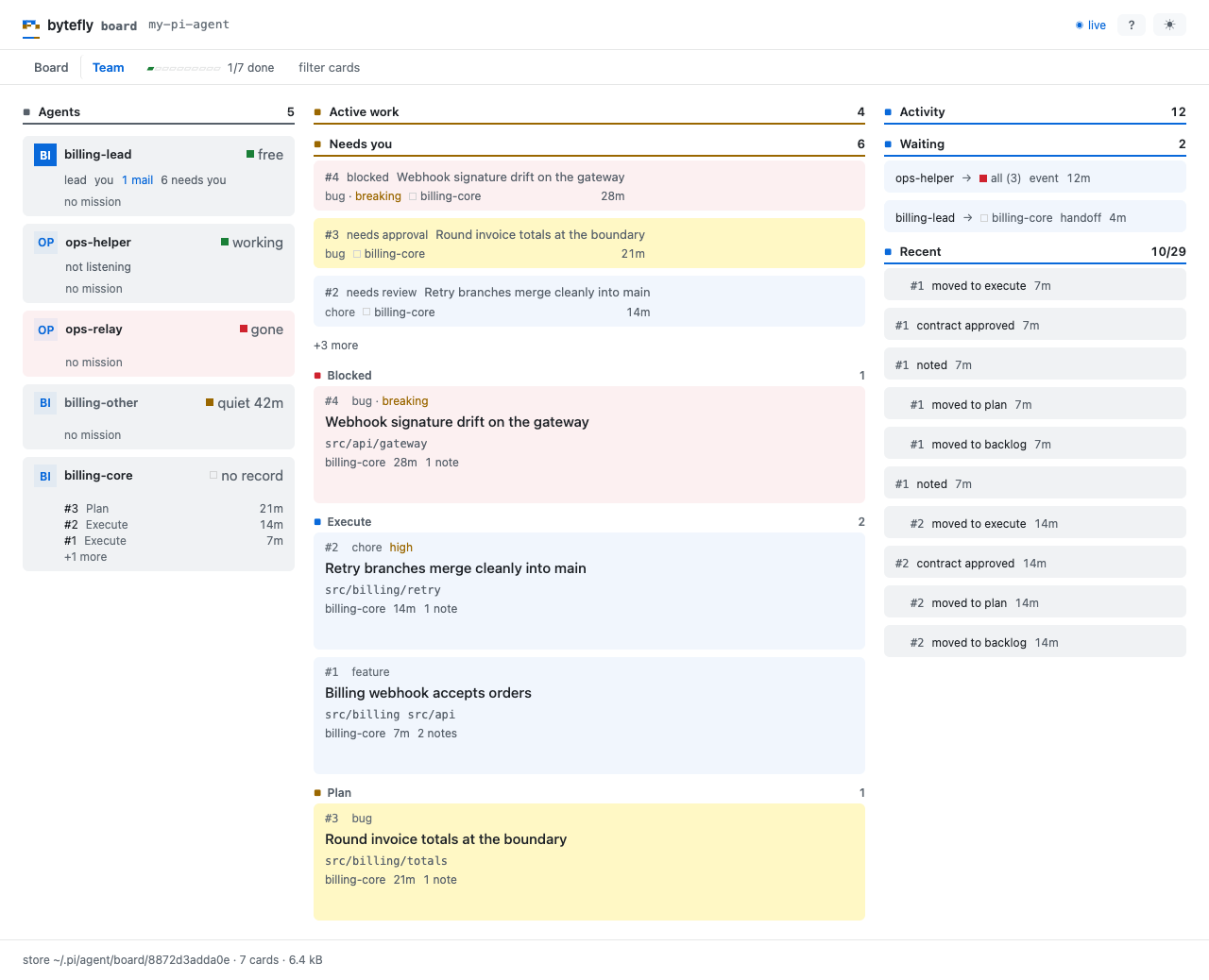
The board’s Team tab is the same round as a page, in three columns that each count themselves and
scroll as one. AGENTS holds a card per session, the lead pinned first: a monogram, its state
and age at the edge, lead and you chips with the mail and needs-you counts, and a mission line
per card. ACTIVE WORK is the lead’s queue over the blocked, execute and plan swimlanes:
one line per ask, the reason printed rather than hovered, filed by whose move it is into YOUR
SIGNATURE, UNCLAIMED and STALLED, none behind a fold — a column per band on a 2K window, and a
phone gives the title the whole line to wrap. ACTIVITY draws unread mail as a block — a fill
and an accent edge — above a flat recent history; reading consumes nothing.
What you can do
| What you want | What to do |
|---|---|
| Hand a card to a running session | team assign 4 to billing-core |
| Offer one to whoever is free | team offer 5 note "whoever is free" |
| Take a card back from a quiet owner | team reclaim 4 |
| Take a card yourself | team claim 5 |
| Ask a peer a question | team ask to billing-core question "what is left on #4?" |
| See the round | /team in the terminal, or the board’s Team tab |
| Join under your own name | /team join billing-core |
Try it
Two sessions, one repository. In the first:
/board
It joins as the lead. In the second, claim a card — that joins it under its own name. Then, from the lead:
team assign 4 to billing-core
The peer is told at its next turn; the card’s owner is billing-core, and the
lead’s round now shows it as held.
Reference
Actions. assign (card, to, note?) joins, then sends a handoff, then records the
owner and whether the bus took the message — told means written, not read, because mail
is pruned after a day; offer (card, note?) broadcasts the card and records only the
moment it was offered, so the first peer to claim it wins; reclaim (card) clears the owner
and returns the card to Backlog with its notes and contract, and its result names the
paths the old holder still has (2 paths stay held by api-core until it stops) — a peer
only from an
owner whose record says it stopped, while the lead takes anybody’s and keeps the
spot-check only its own signer withdraws; claim (card) takes a pool card into
plan for this session; ask (to, question?) sends one peer a question and writes
nothing else: its own ask id, and the answering session by id, so re: <id> matches it.
A flat parameter object means an action refuses a field it does not read, naming
the action that takes it — offer does not take to.
Who is who. /team lists who is live, who is live but not listening, who has gone
quiet (a heartbeat older than ten minutes), and who is not on the bus at all — an owner a card
names that no record answers. A label nobody answers to cannot be handed a card; the result says
so. A card is named by the record its owner’s id carries now, so a rename is one row and not
a live one beside a dead label. A handoff the bus could not name records the owner unresolved:
mail still goes to the label, but only the lead moves the card. A card a quiet owner holds is
reclaimable; one held by a session with no record is not, because a live session that never
joined looks the same. A message to a quiet or not-listening peer says so: written is not heard.
Joining. /board joins you as the lead (team.lead). Another session joins under
its own name — /team join <label> picks it, or the id-derived team-agent- name when it
has none — and a claim, an assign, or an ask makes that join once; a typed label also
joins team.teammates, so the bar’s chip names it. Being on the team never spends a turn.
assign and ask join before they send, because the message names this session
as the way back, and send nothing when the join is refused. A claim writes the card
first and joins after it, so the card is yours either way and the result carries
Not on the team: …. The reason says what to do, and the door is not always
/team join: with no bus loaded it names the extension to turn on, and with the
label held by another record it says whose it is — joining under another name is
the other way, and it costs a lead its signature, because the gates compare
team.lead by label.
Plan mode. Neither team nor session is read-only, so plan mode refuses both
by name; board list still reads. Assign after the plan is approved.
Limits
- Nothing here starts a peer’s process: a peer that never joined cannot be handed a
card, and one listening with
wakeis woken by its mail. - A card somebody already holds is not assignable:
reclaimit, then assign. - An offer is advice — a card can stay offered indefinitely, counted as unassigned, which is the honest signal.
- Ownership does not claim paths: the peer still claims the files it edits through
session. - The lead’s name is a label, not a person: it reaches whoever is serving the page just now, and nothing when nobody is.
Settings
team has no section of its own; the lead name it writes under is team.lead in
the board section of bytefly.json
(configuration). To switch
the extension off, toggle team in /bytefly; a session that keeps board alone
can still move cards itself.
Learn more
- Several sessions — the whole round, from the first claim to the second signature.
board— the cards this round moves.session-bus— the bus every message travels on.- Work a board — one card through both signs.