session-bus — coordinate sessions on one repository
Two Pi sessions on the same repository can get in each other’s way. The bus is the local channel that prevents it: sessions discover each other, exchange short messages, consume an inbox, and claim paths before editing them.
- Local and pull-based. Same machine, same OS user, files under the agent directory — no service, no network, no hidden context.
- Joining is explicit. The board opens empty; a session appears only when it
joins, which every
sessionaction exceptstatusdoes —/boardand/team joinjoin too. - Listening is a mode: mail reported at the next turn, or — with
wake— one raised turn as soon as the agent is idle. Any mail does it: a handoff, an offer, an ask, or a sign wakes awakelistener exactly as any other message does. - Claims are all-or-nothing, on a file or a directory prefix, and they expire with the session.
What you can do
| What you want | What to do |
|---|---|
| See who is working here | /sessions — the board, or the listing outside the TUI |
| Join under a name | /team join billing-core, or session join |
| Message one session | session send to billing-web text "the API route is free" |
| Broadcast an event | session send to "*" kind "event" text "…" |
| Read your mail | session inbox |
| Claim files before editing | session claim paths ["src/api"] |
| Release a claim | session release paths ["src/api"], or x on the board |
| Be woken by mail | session join wake: true |
| Stop listening | w, on the board |
Try it
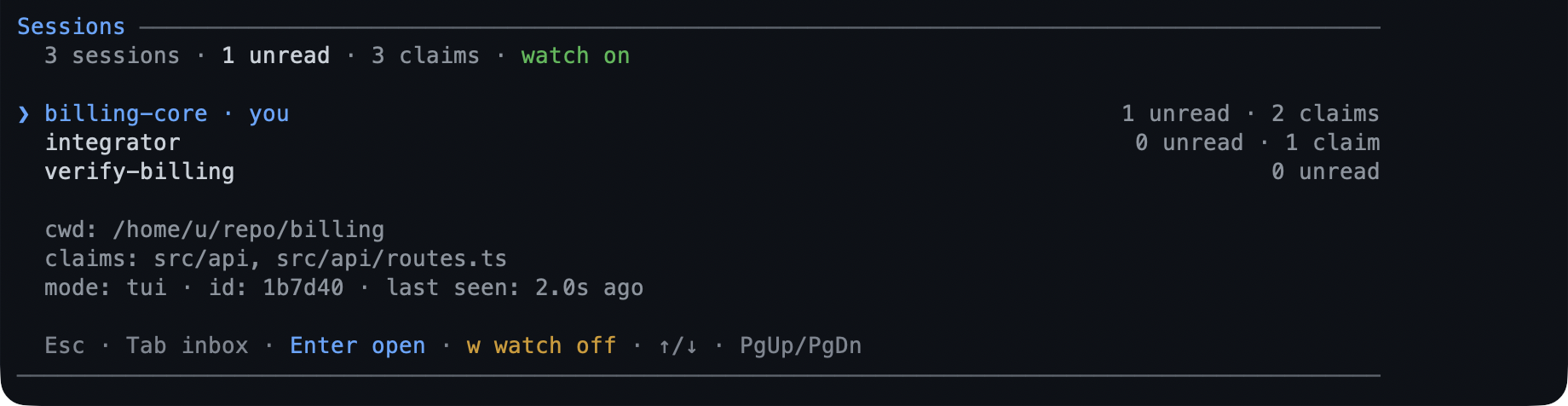
/sessions
The board lists every session with its unread count and claims, plus your own
identity. Tab cycles Sessions, Inbox, and Claims, Enter opens the focused row,
w starts or stops listening, and x releases a claim you hold — after a
confirmation. It joins nothing by itself.
Reference
Actions. session status reads the bus (and never joins you to it);
session send writes one message per recipient, reporting any it could not
reach; session inbox consumes up to limit messages, oldest first;
session claim and session release hold and drop path claims; session join
puts this session on the bus with an optional label, wake, and listen.
Message kinds. message, event, ask, and handoff. An ask does not
block the sender; a handoff names the work it assigns. A message may carry the
repository paths it concerns. A broadcast is one file per recipient sharing one
message id.
Mail is read, not taken, by the page. The board’s Team tab draws the whole
bus’s queue by reading those files, and it removes nothing: an inbox stays its
owner’s to consume with session inbox. The message text is shown on the page —
a loopback, token-guarded page that already reads this directory — and never
marked as read.
Records. session status lists each session with its record’s state — live while its
heartbeat holds, quiet once it has aged, gone once its process is not running — with whether
its watch is armed, so a peer that will not be woken reads as one. The record also carries the
turn: stamped on agent_start and dropped on agent_settled, so the Team tab can draw a
session as working rather than idle from a stale heartbeat. A stamp is believed only beside a
fresh heartbeat — a process that died mid-turn left its stamp behind. Mail is counted per record,
so a message whose recipient’s record has been pruned has no row to carry its number: the status
says so once, as Unaccounted: N unread, until the message TTL ends it, and a session resumed on
that id can still read it.
Labels. Name a session for the outcome it owns (billing-core), not its
layer. A duplicate label gets a short id suffix; a label is reserved while the bus
keeps its owner’s record — ten minutes past the last heartbeat — so a crashed
session has not freed its name and a slow one has not lost it.
Claims. All-or-nothing: if one path conflicts, nothing is claimed. A directory claim conflicts with claims below and above it. Paths resolve against your working directory and are stored relative to the repository root; the repository itself cannot be claimed. There is no forced takeover.
Where it lives. ~/.pi/agent/session-bus/<repo-key>/ — the bus is under the
agent directory, never in the project, so it is never committed.
Limits
- Same machine and OS user only: any process with your file access can read or rewrite it, and there is no authentication between sessions — the agent directory is trusted input.
- Pull-based by default: a message waits for a session that is not listening, and the model reads mail at coordination points.
- Reading is not joining:
/sessionsshows a board you are not on until you join or act. - Membership is per session and does not survive a resume or a restart; unread mail and the derived label do.
- The board acts on your own state only — it never consumes mail or touches a peer’s claims.
- Two listening peers can wake each other in a loop; stop listening on one.
- A fan-out writes one file per inbox, so it can be partial; the result lists both the delivered and the missed.
Settings
The bus has no keys in this version: the heartbeat (10 s), watch poll (2 s), session
TTL (10 min), message TTL (24 h), text cap, and inbox limits are fixed. To switch
the extension off, toggle session-bus in /bytefly: the team goes, while the board
and its cards stay workable without it
(what that costs).
Learn more
- Several sessions — what the bus, the cards, and the lead’s round do together.
team— the lead’s round, over this bus.board— the cards a handoff moves.subagent— delegation inside one session.